When Local Food Gets to Schools, Everybody Wins
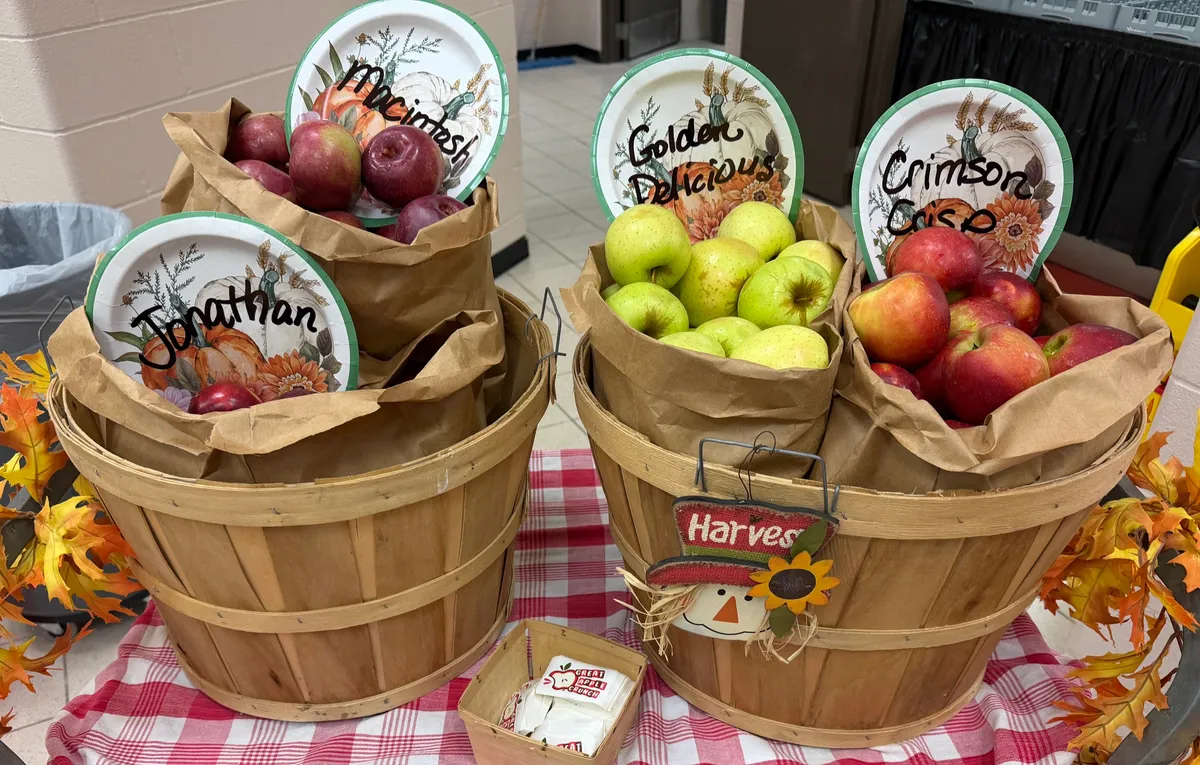
Last week, students at Woodridge Local Schools in Peninsula celebrated the state-wide Apple Crunch Day by tasting four varieties of locally grown apples. Students learned about different apple varieties, voted for their favorites and, as you might expect, had plenty of opinions about which apple came out on top. Staff joined in, too.
The event was fun, but getting bushels of apples into the school was part of a much bigger effort to bring more locally grown food into Woodridge cafeterias.
Tina Hastings, food service director for Woodridge Local Schools, has been working with Pisanick Partners to find more ways to connect the district with local farmers and food producers. One of the challenges is that school food service and farming operate on very different schedules.
“Farmers only have what they have,” Tina says. “So we have to learn to pivot when creating seasonal menus.”
School menus may be planned months in advance, while farmers have to work with weather, growing conditions, and items that are ready for harvest. For a school food service director, adding local food can also mean coordinating with multiple farms, each with its own products, ordering processes, and delivery schedules.
That is where Forest City Food Collective can make a real difference!
For Apple Crunch Day, FCFC connected Woodridge with Quarry Hill Orchard, helping the school get four different varieties of locally grown apples within the timeframe it needed. But the relationship doesn't end with apples. Through FCFC, Woodridge can access products from local farmers and producers without Tina having to manage those individual relationships herself.
“I don’t have time to procure the items from a ton of farmers,” Tina says. “Forest City makes it so much easier for me. They have opened up a whole new world of local products and local farmers for me to get everything from a one-stop shop.”
This relationship has opened the door to a range of products for Woodridge cafeterias, from microgreens that have been used on school pizzas to local yogurt and granola for breakfast parfaits. Locally sourced beef is another possibility the district is currently exploring.
Woodridge is one example of the work Forest City Food Collective has been doing to connect local food producers with schools. The effort began years ago, when Forest City was still operating as the Oberlin Food Hub. In 2018, the organization received a USDA farm-to-school grant and became an Ohio Schools Council Farm-to-School distributor. Since then, the organization says its farm-to-school work has been part of the system that has enabled millions of dollars in local food purchases by school districts around Ohio.
The impact reaches beyond the cafeteria, too. Farm-to-school partnerships have created opportunities for students to learn where their food comes from and how it is grown. Earlier work involving the Oberlin Food Hub included Harvest of the Month programming, culinary training for school food staff and efforts to help schools plan local purchases in ways that work better for farmers. In one Parma City Schools project, locally grown Sungold tomatoes provided by the organization became part of lessons involving science, school gardens, and students taking tomato plants home to grow themselves.
There is a practical reason this kind of infrastructure matters. According to the USDA's 2023 Farm to School Census, 63% of school food authorities reported serving local foods during the 2022–23 school year, with participating districts spending nearly $1.8 billion on local food. At the same time, schools identified the availability and cost of local food among the challenges that can make those purchases difficult.
For a farmer, having a school as a customer can mean access to a significant and reliable market. For a school, buying directly from many individual farms can be difficult to manage. A food hub helps bridge that gap by bringing products from multiple producers into a system that works for institutional buyers.
That is an important part of what Forest City Food Collective means when it talks about food access. It isn't only about making sure people can afford or find local food. It's also about building the relationships and infrastructure that allow local food to reach places where people already are, including school cafeterias.
And that makes a day like Apple Crunch Day about more than apples.
At Woodridge, students got to taste food grown on nearby farms, learn about different varieties, and share the experience with their classmates. Behind this outwardly simple school activity were local farmers, a food service director, and a food distribution hub working together to make it as seamless as possible.
This collaboration is the hallmark of school access: making it easier for schools to buy local food, easier for farmers to reach new markets, and easier for students to have a place at the table. And that’s exactly what Forest City Food Collective is about – making local food available to everyone, everywhere!
Want to be part of the movement to get local food into local schools? Join the collective today as a monthly sustaining donor! Sign up at: https://forestcityfoodcollective.com/donors.
