Designing a System to Bring Good Food to Our Neighbors
“Emergency food fills a gap. Designed systems create stability. We are not just moving good food. We are ensuing reliable access." - Dave Sokoll | Executive Director, Forest City Food Collective
Good food does not move by accident.
It moves because farmers plan for it, communities rely on it, and systems are designed to carry it where it is needed most. Farm-to-Foodbank work lives in that space, where local agriculture and community care meet through intentional design.
Forest City Food Collective partners with regional growers and food access organizations to make sure fresh, locally grown food reaches communities consistently and with dignity. This is not about surplus or short-term response. It is about building systems that farmers and food banks can depend on, season after season.
As one partner at Second Harvest Food Bank shared, this work is about “feeding the line while working to end the line.” It pairs immediate food access with long-term regional stability. Local agriculture contracts are not just hunger relief. They are economic development for our region.

Second Harvest works with more than 130 partner charities and school districts across Crawford, Erie, Huron, and Lorain counties, creating pathways to nutritious food for tens of thousands of neighbors each year.
Another food pantry partner with East Mount Zion Baptist Church’s Lifeline Ministry shared that “when we need produce and traditional channels dry up, these local farmers and FCFC are there with what our families need.”
For more than 40 years, East Mount Zion’s Lifeline Ministy has served Cleveland-area families facing temporary hardship. Each month, they provide a four-day supply of food to households referred by physicians, clergy, and social workers. Their work reflects the reality on the ground. When supply chains falter, reliable regional systems matter.
When Access Depends on Design
Too often, emergency food systems are built around surplus. What happens to be available determines what can be distributed. That approach makes planning difficult, limits access to fresh food, and leaves food banks vulnerable when surplus disappears.
Food banks face constant pressure. Demand is high. Supply shifts. Funding cycles rarely match real needs.
Farmers face parallel uncertainty. Markets fluctuate. Payments can lag. Growing food without a reliable buyer carries risk.
Farm-to-Foodbank work starts by recognizing that these challenges are shared. When farmers and food banks are connected through thoughtful coordination, stability becomes possible on both sides.
What the System Makes Possible
Forest City Food Collective partners with farmers to manage logistics, from sourcing and payment to communications and relationships, so food can move reliably from farms to families. By aggregating supply, coordinating transportation, and aligning purchasing with real demand, the Collective creates pathways farmers and food banks can rely on.

That structure reduces uncertainty, allowing farmers to plan while food banks project supply. Advance purchasing, clear routing, and shared infrastructure enable farmers to grow with confidence and food banks to operate with consistency. Farm-to-Foodbank programs keep food moving where it is needed most.
This system only works because partners and funders invest in the infrastructure behind it. Transportation, purchasing systems, and relationship management are not incidental. They are the backbone that allows food to move consistently instead of reactively.
This work is possible because of the farm partners who have built resilient businesses rooted in planning, discipline, and long-term vision. Their production systems, delivery models, and relationships across the region create the conditions for reliable supply. They are masters of their craft and stewards of the regional food economy. We are honored to work alongside them and learn from them.
Where Shared Effort Meets Real Impact
Today, this system delivers measurable impact:
Over 5 million pounds of produce delivered through Farm-to-Foodbank programs as of February 2026
Farmers invested ~ $700,000 in farm infrastructure
130+ truckloads of nutritious food distributed across the region
Advance-payment contracts piloted to reduce farmer risk
These outcomes reflect a system designed to work, not a temporary solution. This work matters beyond the numbers. When Farm-to-Foodbank systems are strong, the benefits ripple outward.
Farmers gain fair, predictable markets.
Food banks gain reliable access to fresh, local food.
Communities gain nourishment rooted in their own region.
This is how local food strengthens local economies while meeting real needs.
Sustaining the Work
When Farm-to-Foodbank systems are sustained, farmers can plan seasons with confidence, food banks can rely on consistent access to fresh food, and communities are not left waiting on surplus or emergency response.
This work requires ongoing care. Infrastructure, coordination, and trust do not sustain themselves.
Support for this work helps fund the behind-the-scenes effort that keeps food moving reliably. It allows Forest City Food Collective to continue strengthening pathways between farms and communities, even as conditions change.
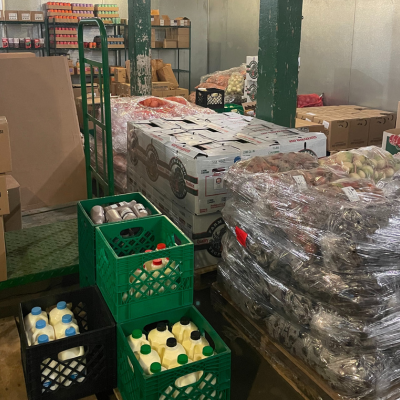
This approach has already taken shape through the Feeding Communities, Growing Farms initiative, developed in partnership with regional feeding partners, including Second Harvest Food Bank and East Mount Zion Baptist Church’s Lifeline Pantry. Building on the Ohio CAN model, the initiative connects small and mid-sized farmers with food banks and pantries through fair market contracts, strengthening regional supply while expanding access to fresh, locally grown produce.
What began with federal support now continues through shared investment from food banks, private donors, corporate partners, and foundations. That diversified funding model reinforces long-term stability rather than short-term response.
There are many ways to take part in this work. Participation looks different for everyone.
Donate to sustain coordination and farmer partnerships
Partner if your organization supports food access or community health
Volunteer to support events and distribution efforts
Sell through the Collective as a grower seeking stable markets
Buy local to reinforce the regional food economy
Each action strengthens a system designed to serve both people and place. Learn how to get involved.
Moving Good Food Forward
Farm-to-Foodbank is one expression of Forest City Food Collective’s broader commitment to redesigning how good food moves. It reflects a belief that when systems are built with care, everyone benefits. This collaborative effort demonstrates a commitment to delivering good food through systems designed for reliability, care, and shared responsibility.
Good food moves when people move together.
